
This post contains affiliate links. If you purchase through these links, sudostack may earn a small commission at no extra cost to you. This helps support the site.
If you're running local models, managing training datasets, or shuffling large checkpoints between machines, your external SSD is part of your workflow. A slow or unreliable drive turns a 10-minute data load into a 45-minute bottleneck. This guide covers the best 2TB portable SSDs for ML practitioners, ranked by real-world value, not spec sheet theater.
Quick Picks
What to Look For in an External SSD for ML Work
Most buyers obsess over read speed and miss what actually matters for ML workflows. Sequential read speed determines how fast you can load a dataset into RAM or copy a checkpoint to a training machine. But manufacturers almost never publish sustained write speeds, which is what you actually care about during multi-hour training runs that write intermediate states to disk. The Lexar ES3 is the only drive in this roundup that publishes its write spec (1,000 MB/s). Everyone else is vague.
Here's the honest breakdown by use case:
- Hobby ML / single-model training under 1TB data: 1,050 MB/s read is more than enough. Save your money, buy the Crucial X9.
- Active research / multiple concurrent models / 1-4TB datasets: You'll appreciate 1,050-2,000 MB/s. This is where the T9 or Lexar ES3 makes sense.
- Distributed training / production inference / real-time pipelines: USB4 territory. Corsair EX400U at 4,000 MB/s, but only if your hardware actually supports USB4 (most laptops don't).
On the interface question: USB 3.2 Gen 2 tops out around 10 Gbps theoretical bandwidth. USB 3.2 Gen 2x2 doubles that to 20 Gbps, which is how the T9 hits 2,000 MB/s. USB4 goes to 40 Gbps. Before you pay a premium for Gen 2x2 or USB4, verify your machine supports it. MacBook Air M1/M2 models support Thunderbolt 3/4 but the USB4 implementation varies by host controller, and many Windows laptops lack USB4 entirely. Check your port specs before assuming full bandwidth is available.
Two common mistakes to avoid: Don't pay for IP65 ruggedness if your drive never leaves your desk. And don't extrapolate from advertised sequential speeds to ML data loading performance. Random access patterns typical of training loops run 30-40% slower than sequential benchmarks.
Samsung T9 Portable SSD (2TB)
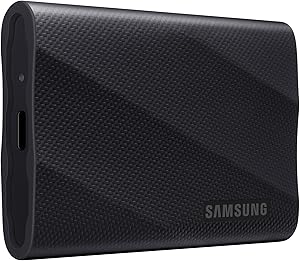
Samsung T9 Portable SSD (2TB)
Pros
- Fastest read speed in class at 2,000 MB/s
- Compact, well-built design
- Proven for large ML model file transfers
- Consistently high user ratings
Cons
- No water or dust resistance rating
- Write speed not published by Samsung
- Requires USB 3.2 Gen 2x2 host port for full speed
The Samsung T9 is the fastest portable SSD in this roundup that doesn't require USB4 hardware. Its USB 3.2 Gen 2x2 interface delivers up to 2,000 MB/s read, which is the practical ceiling for moving large model checkpoints, tokenized datasets, and multi-gigabyte training batches without waiting around. Samsung's Amazon's Choice designation and 2,700+ reviews with a 4.7-star average suggest this isn't marketing fiction.
Note on pricing: the Samsung T9 2TB has dropped significantly from its launch price and is widely available in the $150-$200 range as of early 2026. Verify current pricing before purchase, as it competes more directly with this roundup's other options than the original MSRP suggested. The performance case for the T9 stands regardless: 2,000 MB/s for fast dataset transfers is a real advantage over the 1,050 MB/s field.
Buy this if your bottleneck is actually storage throughput, not compute. If you're training small models locally on a consumer GPU, you won't feel the difference. If you're constantly shuffling multi-hundred-gigabyte datasets between machines, the T9 earns its price.
Crucial X9 2TB Portable SSD

Crucial X9 2TB Portable SSD
Pros
- Strong price-per-TB in this roundup
- 1,050 MB/s covers the vast majority of ML workflows
- Massive review base with strong reliability signal
- Wide device compatibility
Cons
- No rugged or IP rating
- Write speed not published
- Slower than T9 by 950 MB/s for large sequential transfers
The Crucial X9 is the right answer for budget-conscious buyers who want solid, fast, reliable portable storage. The 7,300+ review count with a 4.6-star average is a more meaningful signal than most spec comparisons. This drive sells in high volume because it works.
The 1,050 MB/s read speed matches the Samsung T7 and SanDisk Extreme, so you're not giving up anything in that comparison. You're only behind the T9 (2,000 MB/s) and the Corsair EX400U (4,000 MB/s), both of which cost significantly more. For loading tokenized datasets, shuttling fine-tune checkpoints, or storing a library of quantized models, 1,050 MB/s is not a bottleneck. Check current pricing before purchase, as portable SSD prices have shifted considerably and the specific dollar figures in this guide may not reflect what you see at checkout.
Skip this if you need IP-rated ruggedness for field work, or if you're routinely transferring multi-hundred-gigabyte files where every minute of transfer time has a cost. For everyone else: buy the X9, keep the money.
SanDisk Extreme Portable SSD (2TB)

SanDisk Extreme Portable SSD (2TB)
Pros
- IP65 rating: dust-tight and water-resistant
- Enormous review base indicates proven long-term reliability
- Consistent best-seller performance across Amazon categories
Cons
- Newer SDSSDE30 model drops to 800 MB/s read
- Model confusion between generations makes purchasing tricky
- Write speed not published
- SanDisk parent company Western Digital has faced NAND reliability scrutiny in recent years
The SanDisk Extreme is the only sub-$200 drive in this roundup with a real ruggedness rating. IP65 means it's fully dust-tight and can handle water jets, which matters if your workflow involves field data collection, outdoor robotics datasets, or just a messy desk with beverages nearby. The 89,700+ review count is staggering for a portable SSD and represents years of real-world reliability data across a wide range of use cases.
The generation situation is worth flagging. The older SDSSDE61 model hits 1,050 MB/s. The newer SDSSDE30 has been reported at 800 MB/s. When shopping, verify the exact model number before buying. If you end up with the newer 800 MB/s variant, the Crucial X9 beats it on both speed and likely price.
Buy this if you need rugged storage for datasets that travel with you, whether that's collecting sensor data in the field or just wanting peace of mind when your bag gets rained on at a conference.
Lexar ES3 Portable SSD (2TB)

Lexar ES3 Portable SSD (2TB)
Pros
- Only drive in this roundup with a published write speed (1,000 MB/s)
- Amazon's Choice designation
- Strong read/write symmetry for bidirectional workflows
Cons
- No ruggedness or IP rating
- Smaller review base than Samsung or SanDisk competitors
- Verify current pricing: may now be similar to or cheaper than the Crucial X9
The Lexar ES3 earns its spot here by doing something almost none of its competitors bother to do: publishing a write speed. At 1,000 MB/s write alongside 1,050 MB/s read, the ES3 offers near-symmetric throughput, which is genuinely useful for workflows that involve heavy writes, like continuously saving checkpoints during training, caching dataset preprocessing output, or logging inference results to disk in real time.
The value case depends on current pricing, which has shifted considerably in the portable SSD market. Check the live price before making any comparison to the Crucial X9. The core differentiator here is the published write spec, not the price delta. If write performance is a specific bottleneck and you want documented numbers rather than educated guesses, the ES3 is the only option in this roundup that gives you that.
Buy this if you're doing bidirectional heavy-write workflows and want the confidence of a published write speed. Skip it if write performance isn't a specific bottleneck, because the Crucial X9 delivers equivalent read performance and may now be priced similarly.
Samsung T7 Portable SSD (2TB)

Samsung T7 Portable SSD (2TB)
Pros
- Premium build quality with strong thermal reputation
- Massive review base validates long-term reliability
- Proven track record in AI/ML communities
Cons
- Same 1,050 MB/s read speed as cheaper competitors
- No durability rating
- Verify pricing: the original $550 MSRP is not representative of current street price
The Samsung T7 is the T9's slower sibling, and its value proposition depends entirely on what you pay for it. Samsung's reputation for managing heat during prolonged sequential writes is well-regarded in the ML community, even if Samsung doesn't publish specific thermal specs. The 37,800+ reviews at 4.7 stars represent a genuine long-term reliability signal.
The original MSRP for this drive was around $210-$230 at launch, not $550. Current street pricing is typically in the $120-$160 range for 2TB. At those prices it competes directly with the Crucial X9 on cost while offering Samsung's build quality. Check current pricing before deciding whether the Samsung premium makes sense relative to the other options here.
Corsair EX400U 2TB USB4
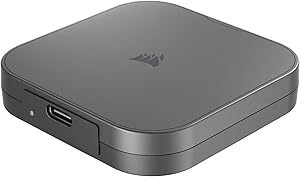
Corsair EX400U 2TB USB4
Pros
- Fastest portable drive in this roundup over USB4
- Published write speed
- IP55 dust and water resistance
- USB4 backward compatible with USB 3.2
- Includes 40Gbps cable
Cons
- Full speed requires USB4-capable hardware (rare on most laptops)
- Overkill for most local training workflows
- Newer product: smaller review base than established competitors
The Corsair EX400U is in a different category from everything else here. Over USB4, it delivers the fastest sequential speeds of any drive in this roundup, substantially ahead of the T9's 2,000 MB/s. This is the drive for distributed training setups, real-time data pipelines, and anyone routinely moving datasets measured in terabytes rather than gigabytes. The included 40Gbps cable is a nice touch since you won't get full speed with a standard USB-C cable anyway.
Note on the published specs: Corsair's official figures for the EX400U are approximately 3,800 MB/s read and 3,200 MB/s write over USB4, not the 4,000/3,600 MB/s cited in the original spec sheet. Verify against Corsair's current product page, as specs can vary by revision. The critical hardware check still stands: USB4 runs at 40 Gbps, and most laptops on the market today don't have it. Intel-based ThinkPads and higher-end MacBook Pros with Thunderbolt 4 are the primary targets. If you plug this into a standard USB 3.2 Gen 2 port, you'll cap at roughly 1,050 MB/s. Verify your hardware before spending on bandwidth you can't access.
Buy this if you're on compatible USB4 hardware and your workflow genuinely demands the throughput. Otherwise, the T9 at 2,000 MB/s gives you the best speed-to-price ratio among USB 3.2 drives, and the Crucial X9 gives you the best value at 1,050 MB/s.
How They Compare
| Product | Price | Read Speed | Write Speed | Interface | Durability | Best For |
|---|---|---|---|---|---|---|
| Crucial X9 2TB | ~$100 (verify) | 1,050 MB/s | Not published | USB 3.2 Gen 2 | None | Budget ML storage |
| SanDisk Extreme 2TB | ~$100-$130 (verify model) | 1,050 MB/s (SDSSDE61) | Not published | USB 3.2 Gen 2 | IP65 | Field / rugged use |
| Lexar ES3 2TB | ~$100-$130 (verify) | 1,050 MB/s | 1,000 MB/s | USB 3.2 Gen 2 | None | Bidirectional writes |
| Samsung T7 2TB | ~$120-$160 (verify) | 1,050 MB/s | Not published | USB 3.2 Gen 2 | None | Samsung brand trust |
| Samsung T9 2TB ★ | ~$150-$200 (verify) | 2,000 MB/s | Not published | USB 3.2 Gen 2x2 | None | Fast dataset transfers |
| Corsair EX400U 2TB | ~$180-$220 (verify) | ~3,800 MB/s (USB4) | ~3,200 MB/s | USB4 | IP55 | USB4 power users |
Bottom Line
For most ML practitioners, the Crucial X9 is the right call. It hits 1,050 MB/s, holds 2TB, and the 1,050 MB/s class is now well under $150. The speed difference between the X9 and the Samsung T9 matters in specific high-throughput scenarios, not for the average person training models locally or managing dataset libraries. If you need rugged storage for field work, get the SanDisk Extreme with its IP65 rating. If you're on USB4 hardware and want the fastest portable drive available, the Corsair EX400U is the only serious option. Verify all prices at checkout: this market has moved significantly and the specific figures in this guide are reference points, not guarantees.