
This post contains affiliate links. If you purchase through these links, sudostack may earn a small commission at no extra cost to you. This helps support the site.
Resin printing under $500 has quietly gotten very good. In 2026, you can get 12K or even 16K resolution, heated resin tanks, and auto-leveling without touching a mid-market budget. This guide covers six printers from ~$190 to ~$500, ranked and compared for two specific audiences: tabletop miniature painters who want clean detail at scale, and jewelry makers who need surface precision that holds up at macro photography distances.
Quick Picks
What to Look For
Resolution marketing in resin printing is noisy. The K-class numbers (8K, 10K, 16K) refer to the pixel count across the LCD panel, and the practical difference between 10K and 12K is invisible at normal tabletop viewing distances. What actually moves the needle for miniatures and jewelry is XY pixel size in microns: lower is sharper. The Phrozen Sonic Mini 8K S, for example, advertises 22µm pixels, which is more useful information than the K-class label.
Beyond resolution, three specs matter:
- Build volume Z-axis height. This limits the maximum height of a single print. A 6.5" Z-axis handles most miniatures easily, but larger display pieces or tall jewelry forms may require splitting models.
- Print speed (mm/h). Faster speeds compress your project timeline significantly. Going from 70 mm/h to 150 mm/h roughly halves print time for tall models. Speed miscalibration causes layer separation, so faster machines reward experienced users more than beginners.
- Heated resin tank. Only the Saturn 4 Ultra in this guide includes one. In rooms below 20°C, unheated tanks cause adhesion failures and wasted prints. If your workspace runs cold, this feature alone may justify the higher price.
Common mistakes to avoid: don't size down to save money and then immediately regret the tiny build plate when you want to print a batch of 20mm bases. Don't skip ventilation planning. And factor in resin costs: at roughly ~$20 to ~$50 per kilogram depending on resin type, a fast machine running daily will cost you more in consumables than in hardware within a year.
Budget tiers shake out cleanly here. Under ~$250, you're getting a functional but limited machine, best for learning. From ~$250 to ~$400, you hit the sweet spot for serious hobbyists. Above ~$400, you're buying quality-of-life features (heated tanks, smart sensors) that reduce failure rates rather than delivering dramatic jumps in output quality.
Anycubic Photon Mono 4
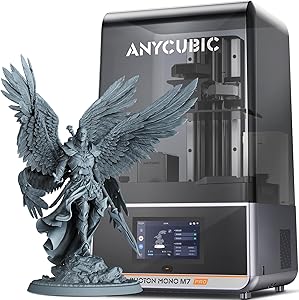
Anycubic Photon Mono 4
Pros
- Genuine 10K resolution under ~$200
- Strong community and tutorial ecosystem
- 4.4/5 stars across 477 Amazon reviews
- Compact footprint for small workspaces
Cons
- Slowest print speed in this guide (70 mm/h)
- No heated resin tank
- Smallest build volume of any option here
The Photon Mono 4 earns its place as the entry point by actually delivering on resolution. At around ~$190, you're getting a 10K panel that handles standard 28mm to 32mm miniatures cleanly, with enough detail for tabletop paint jobs. The 477 Amazon reviews at 4.4/5 suggest this isn't a bait-and-switch product; it performs as advertised for its intended use case.
The 70 mm/h print speed is the real constraint. A tall miniature that takes 90 minutes on the Mars 5 Ultra will take over three hours here. If you're printing one or two models a week as a hobby, that's fine. If you're trying to build out a full army or run a small side business, the time cost adds up fast. The missing heated tank also means cold workshops (under 20°C) will cause headaches with adhesion until you dial in exposure compensation.
Buy this if you're new to resin printing, have a warm workspace, and want to spend as little as possible while still getting output quality that embarrasses most FDM machines. Skip it if speed or batch capacity matters to you.
Elegoo Mars 5 Ultra
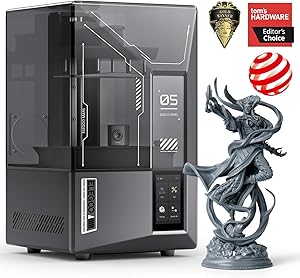
Elegoo Mars 5 Ultra
Pros
- Fastest speed in the sub-$300 range (150 mm/h)
- WiFi file transfer and auto-leveling reduce setup friction
- Strong Elegoo ecosystem and resin compatibility
- 4.2/5 stars with 322 Amazon reviews
Cons
- 9K resolution trails competitors at similar prices
- Build volume no larger than the budget Mono 4
- No heated resin tank
The Mars 5 Ultra is the top pick because it gets the trade-offs right for most users. The 150 mm/h print speed is more than double the Photon Mono 4, which is the kind of difference you feel immediately in your workflow. WiFi file transfer sounds like a small thing until you've done the USB shuffle a dozen times. Smart auto-leveling removes the most common source of beginner print failures. Elegoo's ecosystem is mature, with abundant slicer profiles, community support, and broad resin compatibility.
Yes, the 9K resolution is lower on paper than the Photon Mono 4's 10K or the Phrozen's 22µm pixels. In practice, at tabletop viewing distances, 9K is indistinguishable from 10K for painted miniatures. The resolution difference only becomes relevant if you're printing jewelry for close inspection or selling unpainted miniatures where surface texture is visible to buyers.
This is the right machine if you want a capable, low-friction resin printer for tabletop work without spending ~$350 or more. It handles FDM upgraders well because the auto-leveling and WiFi reduce the learning curve significantly. If your primary use is display-quality jewelry or you need a larger build plate, read on.
Phrozen Sonic Mini 8K S

Phrozen Sonic Mini 8K S
Pros
- 22µm XY pixels deliver exceptional surface detail
- Purpose-built for miniatures and jewelry workflows
- Premium brand reputation in maker community
- 4.4/5 stars across 148 Amazon reviews
Cons
- Smallest Z-axis build height limits tall or large prints
- Less community documentation than Elegoo or Anycubic
- Print speed not listed in available specs
Phrozen occupies a specific niche: makers who treat resolution as the primary spec and build volume as secondary. The 22µm XY pixel size is the sharpest in this guide, and it shows in output. Community feedback from miniature painters consistently cites surface texture and edge definition as noticeably better than Elegoo Mars-class machines at this price. For jewelry work where clients inspect pieces under magnification, that gap is meaningful.
The trade-off is ecosystem maturity. Elegoo and Anycubic have years of community-generated slicer profiles, exposure guides, and troubleshooting threads. Phrozen's user base is smaller and more specialized, which means fewer resources when something goes wrong. The narrower Y-axis build dimension (2.8") also limits how many models you can plate simultaneously, which slows down batch workflows for miniature painters running multiple projects.
The Sonic Mini 8K S is the right choice if your primary output is jewelry or display-quality miniatures where surface perfection justifies the trade-offs. If you want a do-everything machine at a similar price, the Mars 5 Ultra or Saturn 3 serves you better.
Elegoo Saturn 3 MSLA 12K

Elegoo Saturn 3 MSLA 12K
Pros
- Largest build volume in this guide by a significant margin
- 12K resolution handles jewelry and display-quality miniatures
- Voxeldance Tango slicer included removes software friction
- 4.2/5 stars with 274 Amazon reviews
Cons
- Larger footprint demands dedicated workspace
- Heavier and more involved setup than compact models
- No heated resin tank despite higher price
The Saturn 3's 9.84" Z-axis and nearly 9" x 5" build plate fundamentally change what you can accomplish in a single print session. Miniature painters can plate full squads of 28mm models in one run. Jewelry designers can print multiple rings, pendants, or prototype iterations simultaneously without queuing jobs. At around ~$350, the price-to-volume ratio is the best in this guide, and the 12K resolution is more than adequate for detailed output at either use case.
The catch is physical scale. This is a large machine that needs a dedicated table, good ventilation, and enough room to maneuver the build plate over a wash station. Users who underestimate the footprint consistently mention workspace regret in community reviews. The print speed sits in the 80 to 100 mm/h range rather than the 150 mm/h of the Mars 5 Ultra, though the larger plate compensates by letting you print more models per job.
If you're painting armies, printing production runs of jewelry casts, or just want the most build volume your budget can buy under ~$400, the Saturn 3 is the clear choice. If you're printing one or two models at a time and space is limited, a Mars-class machine serves you better.
Creality Halot-X1 Combo

Creality Halot-X1 Combo
Pros
- 16K resolution at ~$399 is the best resolution-per-dollar in this guide
- Fastest overall print speed (170 mm/h)
- Fully assembled out of the box
- Creality brand support and reliability track record
Cons
- Shorter Z-axis (7.87") than Saturn competitors
- Resin management system compatibility with third-party resins unconfirmed
- Less resin-specific community content than Elegoo or Anycubic
Creality is well-known for FDM machines, and the Halot-X1 Combo is their push into premium resin territory. The specs are genuinely impressive for the price: 16K resolution with 14 x 19µm pixel dimensions, 170 mm/h print speed (the fastest in this guide), and a fully assembled unit that skips the build-plate-leveling ritual that trips up new resin printer owners. At around ~$399, you're getting resolution and speed that costs more in the Elegoo Saturn 4 Ultra.
The caveat worth flagging: Creality's "intelligent resin management" system isn't fully documented in available specs regarding third-party resin compatibility. If it requires proprietary cartridges, your consumable costs go up and your flexibility goes down. Community feedback on this is still thin given how recently the unit launched. Creality's FDM support record is solid, but resin-specific troubleshooting resources are sparse compared to the Elegoo ecosystem.
The Halot-X1 is worth serious consideration if you want near-Saturn-4-Ultra performance at a lower price and can tolerate some uncertainty around the resin system. If that ambiguity bothers you, the Saturn 4 Ultra offers a proven heated tank and documented specs.
Elegoo Saturn 4 Ultra 16K
Elegoo Saturn 4 Ultra 16K
Pros
- 16K resolution with heated tank is the most complete spec sheet in this guide
- Heated resin tank reduces cold-climate adhesion failures
- Smart mechanical sensor and auto-leveling minimize user errors
- Amazon's Choice designation with 100+ monthly sales
Cons
- Pushes the ~$500 ceiling (sale price ~$494, typical ~$520)
- Requires dedicated workspace; not a compact machine
- Resolution benefits over 12K are minimal at tabletop scale
The Saturn 4 Ultra is the most complete machine in this guide. Sixteen-K resolution, 150 mm/h print speed, a large build plate, and the only heated resin tank in the lineup. The 30°C tank heating matters practically: it stabilizes resin viscosity across seasonal temperature swings, which directly reduces the most common source of print failures for users in northern climates or unheated workshops. Combined with smart auto-leveling and mechanical sensor validation, this machine actively works to keep your prints succeeding.
The honest question is whether the Saturn 4 Ultra is worth roughly ~$200 more than the Mars 5 Ultra. For tabletop miniatures viewed from arm's length, no. The resolution jump from 9K to 16K delivers negligible visible improvement on a painted 28mm model. Where it earns the premium is jewelry work at close inspection, display-quality pieces, or production workflows where failed prints cost real money in wasted resin and time. The heated tank alone justifies the upgrade if you've ever lost a build plate full of prints to a cold morning.
Buy the Saturn 4 Ultra if you're serious about jewelry, running semi-professional output, or tired of babying your prints through temperature-sensitive resin behavior. If you're a hobbyist who prints casually, the Mars 5 Ultra gives you 80% of the experience at roughly half the price.
Side-by-Side Comparison
| Product | Price | Resolution | Build Volume (Z) | Print Speed | Best For |
|---|---|---|---|---|---|
| Anycubic Photon Mono 4 | ~$190 | 10K | 6.49" | 70 mm/h | Budget entry point |
| Elegoo Mars 5 Ultra ★ | ~$285 | 9K | 6.49" | 150 mm/h | Best overall value |
| Phrozen Sonic Mini 8K S | ~$300 | 22µm pixels | 6.7" | N/A | Fine detail, jewelry |
| Elegoo Saturn 3 MSLA 12K | ~$350 | 12K | 9.84" | ~80 to 100 mm/h | Batch volume, armies |
| Creality Halot-X1 Combo | ~$399 | 16K (14x19µm) | 7.87" | 170 mm/h | Speed and resolution |
| Elegoo Saturn 4 Ultra 16K | ~$494 | 16K | 8.66" | 150 mm/h | Professional output |
Bottom Line
For most people reading this, the Elegoo Mars 5 Ultra at around ~$285 is the right printer. It's fast, well-supported, auto-leveling, and WiFi-connected, all without asking you to spend ~$350 or more. If you need maximum build volume for batch work, step up to the Saturn 3. If you're doing professional jewelry and cold-climate printing is a real concern, the Saturn 4 Ultra's heated tank justifies the price. The Phrozen Sonic Mini 8K S is the specialist pick for jewelers who prioritize pixel-level detail above everything else. Skip the Photon Mono 4 unless your budget is genuinely capped at around ~$200.